Why Rayados Matters to Monterrey
In a city that built its fortune on steel, glass and beer, the football club feels less like a team than a civic institution. Club de Fútbol Monterrey, known to everyone as Rayados, was founded on 28 June 1945 by a group of local industrialists, which makes it the oldest professional club in all of northern Mexico. That age matters here. Monterrey is a young, fast, money-minded metropolis, and the club is one of the few threads that ties the modern industrial city to the generations that came before it.
The nickname tells you most of what you need to know about the identity. Rayados means "the striped ones," a reference to the navy-and-white vertical stripes the team has worn for most of its history and that still anchor the crest. Fans also call the club La Pandilla, "the gang." The colors are everywhere on a match weekend, draped over balconies in Guadalupe and San Pedro, flying from car windows on the way to the stadium, painted across the faces of children who have supported this team since before they could read.
For a regiomontano, allegiance is rarely casual. The city is split down the middle between Rayados and their younger crosstown rivals, Tigres, and which side of that line you fall on is a piece of personal biography, inherited like a surname or a family recipe for cabrito.
A History Built on Trophies
Monterrey waited four decades for its first league crown, finally lifting the title in the 1985-86 season. A second followed in the Clausura 2003. Then came the club's golden era. Under the ownership of FEMSA, the beverage and retail giant behind Coca-Cola FEMSA and OXXO, Rayados built one of the deepest squads in the country and won back-to-back league titles in the Apertura 2009 and Apertura 2010. The fifth and most recent league championship arrived in the Apertura 2019. Five Liga MX titles in total, each one celebrated in the streets around the Macroplaza.
The club's continental record is, if anything, more impressive than its domestic one. Monterrey won the CONCACAF Champions League three years running, in 2011, 2012 and 2013, a dominant run that briefly made them the undisputed kings of the region. They added a fourth crown in 2019 and a fifth in 2021, a haul of five continental titles that no other Mexican club of the modern era has matched. The trophy cabinet also holds a 1993 CONCACAF Cup Winners' Cup and three editions of the Copa MX, the most recent in the 2019-20 season.
Those continental titles earned Monterrey a seat at the FIFA Club World Cup against the best teams on the planet. The club reached the third-place match twice, in 2012 and again in 2019, the latter run featuring a memorable semi-final against Liverpool that Rayados lost only to a late goal. For a club from northern Mexico to twice finish third in the world is a point of genuine pride here, and supporters bring it up often.
El Gigante de Acero
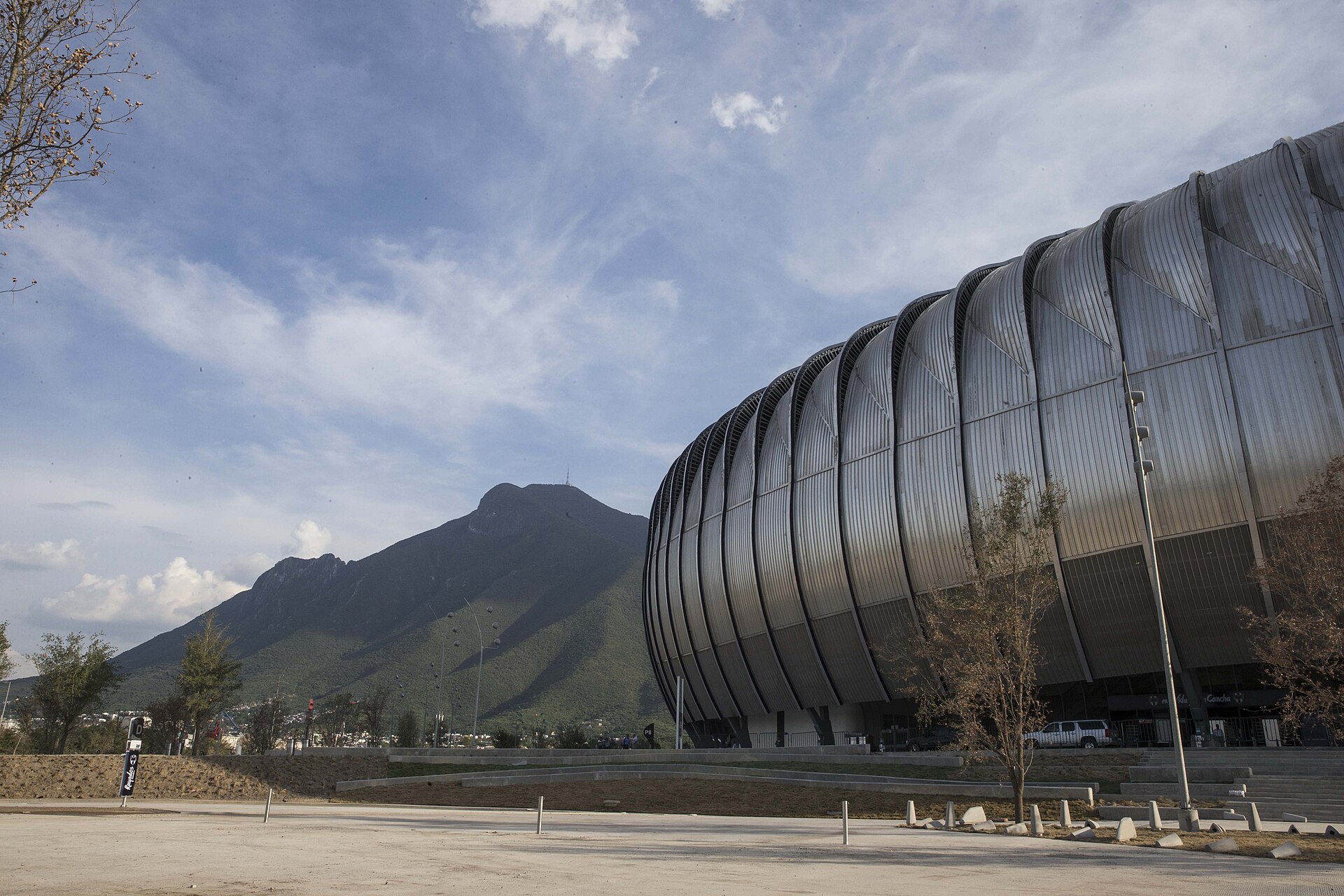
The home ground is a destination in its own right. Estadio BBVA opened on 2 August 2015 in Guadalupe, on the eastern edge of the metropolitan area, replacing the cramped old Estadio Tecnológico. Its metallic exoskeleton earned it the nickname El Gigante de Acero, the Steel Giant, a nod to the city's century-old identity as Mexico's steel capital. Capacity figures vary by source and configuration, generally cited between roughly 51,000 and 53,500.
What makes the stadium unforgettable is not the steel but the view. From the open end behind one goal, spectators look straight out at Cerro de la Silla, the saddle-shaped mountain that is Monterrey's natural emblem. Few stadiums anywhere frame a city's landscape so perfectly. The bowl is steep and the lower stands sit close to the pitch, so sound has nowhere to escape; on a big night the noise rolls back down onto the field and turns the place into a genuine fortress.
The Steel Giant is now preparing for its largest stage yet. Estadio BBVA has been selected as one of three Mexican venues for the 2026 FIFA World Cup, scheduled to host several matches including group-stage fixtures and a knockout game. For a club and a city that have long felt overshadowed by Mexico City and Guadalajara, hosting the world is a long-awaited validation.
Legends and the Modern Galácticos
Ask an older Rayado about the club's heroes and the conversation usually starts with Humberto Suazo. The Chilean striker, nicknamed "Chupete," remains one of the most prolific goalscorers in club history and was the spearhead of the championship sides around 2009 and 2010. Names like Guillermo Franco, the Argentine-Mexican forward, and homegrown favorite Aldo de Nigris are spoken of with the same warmth. These were the players who turned a respectable club into a serial winner.
In recent years FEMSA's money brought a different kind of star to Monterrey: established European internationals in the late stages of glittering careers. Spanish playmaker Sergio Canales arrived from Real Betis and became the creative heartbeat of the team, while Real Madrid and Spain legend Sergio Ramos signed in 2025 and gave the league a global headline. Both, however, have since moved on; Ramos declined to renew for 2026 and Canales departed in April 2026, closing a brief but glamorous chapter.
Beyond the imports, the current squad still leans on a Mexican core that includes attackers such as Germán Berterame and Víctor Guzmán and defender Erick Aguirre, alongside emerging academy talent. The club's challenge for 2026 is to rebuild its identity around that homegrown spine rather than around marquee names.
La Adicción and the Clásico Regiomontano
The beating heart of the support is La Adicción, the club's principal ultras group, whose songs and choreographed tifos fill the south end of the stadium. Their anthem, "Dale Rayados," echoes around the bowl from well before kickoff, and on derby days the visual displays can be spectacular. There is an ongoing, good-natured tension between the ultras' grassroots passion and the club's polished, family-friendly corporate presentation, a tension common to many modern, well-funded clubs.
Nothing focuses that passion like the Clásico Regiomontano, the derby against UANL Tigres. It is widely regarded as one of the fiercest rivalries in Mexican football, second only to the Clásico Nacional between América and Chivas. The match carries a class and cultural subtext as well as a sporting one: Tigres grew out of the public university and a working-class following, while Rayados, backed by FEMSA, are often cast as the establishment club. Whichever framing you prefer, the two stadiums on derby day are among the loudest places in the country.
The rivalry has only sharpened as both clubs spend heavily and chase the same titles. A Clásico Regio can swing a season, settle a playoff, and define a year, and the city effectively shuts down around it.
How to Catch a Match
Seeing Rayados at home is one of the best sporting experiences in northern Mexico, and it is very doable for a visitor. Tickets are sold through the club's official channels and Ticketmaster México, as well as at the stadium box offices, with online sales typically open until a few hours before kickoff. Prices vary widely by opponent and seat; a routine league fixture is affordable, but a Clásico Regio or a playoff match commands a steep premium and sells out fast, so buy early for the big games.
Estadio BBVA sits in Guadalupe at Avenida Pablo Livas, on the eastern side of the metro area and a fair distance from the central tourist zones around the Macroplaza and Barrio Antiguo. There is no direct metro line to the gates, so most visitors arrive by car or rideshare; budget extra time, because traffic and parking around the stadium are heavy on match days. Arriving well before kickoff lets you soak up the pre-match atmosphere and avoid the worst of the crush.
A few etiquette notes. Wear blue and white if you want to blend in, and avoid the orange-blue of Tigres in mixed areas on derby weekends. Bags are searched at the gates, the sun and heat can be brutal for afternoon kickoffs, so bring water and sunscreen, and join in with the chants even if you do not know the words. Regiomontanos are proud, warm hosts, and a visitor who shows genuine enthusiasm for the spectacle will be welcomed.
The Current State of the Club
The 2025-26 season has been a turbulent one off the pitch. Despite the heavy investment in stars, Rayados endured a difficult Clausura 2026 and parted ways with head coach Domènec Torrent in March 2026. Club legend Nicolás Sánchez stepped in as interim manager but was let go at the end of April after results failed to improve. In May 2026 the club confirmed the experienced Argentine Matías Almeyda, "El Pelado," as the new head coach for the Apertura 2026 tournament.
That instability sits against the backdrop of a club that has not lifted a league title since 2019, an unusually long drought by the standards of FEMSA's ambitions. The departures of Ramos and Canales mark the end of the recent galáctico experiment, and the task facing Almeyda is to forge a more sustainable, homegrown team capable of competing for trophies again.
Whatever the league table says in any given season, the foundations remain enormous: one of the wealthiest ownerships in Mexican football, a world-class stadium about to host the World Cup, a fanatical support base, and eighty years of history. Rayados de Monterrey is not just a team chasing its next title; it is, for a large part of this city, a permanent way of belonging.