Why Tigres Matters to Monterrey
There are two football clubs in the Monterrey metropolitan area, and which one a person follows says a great deal about them. Rayados de Monterrey, the older institution, was long the club of the city's industrial establishment. Tigres de la UANL grew up on the other side of that divide: born inside the public Universidad Autónoma de Nuevo León, it became the club of students, of the university's working-class commuter belt, and of San Nicolás de los Garza, the dense municipality where its stadium stands. The yellow shirt is not just a team color in Nuevo León; it is a social marker.
That origin is the whole point. Tigres carries the name and crest of a state university rather than a corporation, and for decades its identity has been wrapped up in being the team of the regular person — the one whose family did not own the steel mill but worked in it. When the club climbed from a 1996 brush with relegation to lifting championship after championship in the 2010s, that arc read to its supporters like proof that the underdog could win on the biggest stage in the country.
The result is a fanbase whose devotion outstrips the club's age. Founded in 1960, Tigres is younger than many of Liga MX's grand institutions, yet visitors who attend a match quickly understand that few stadiums in Mexico generate the noise, color, and sheer density of feeling that this one does.
History and Honors
Club de Fútbol Tigres de la Universidad Autónoma de Nuevo León was founded on 7 March 1960. Its first major silverware came in the mid-1970s Copa México, when it became the first club from Nuevo León to win an official national title, and it added back-to-back league crowns in 1977-78 and 1981-82. Then came a long drought — decades in which Tigres flirted with the bottom of the table, including the 1996 relegation fight that, paradoxically, would forge its most famous supporters' group.
The modern golden era began in the 2010s and reshaped the club's entire reputation. Tigres has now won eight Liga MX league titles. Beyond the two early championships, the haul includes Apertura 2011, Apertura 2015, Apertura 2016, Apertura 2017, Clausura 2019 and Clausura 2023 — a run of dominance in the second half of the 2010s that few Mexican clubs have matched in any era.
The continental and global stage tells the rest of the story. Tigres reached the final of the 2015 Copa Libertadores, the South American club championship, falling short but signaling its ambition. In 2020 it won the CONCACAF Champions League, the region's top club competition, and that triumph carried it to the 2020 FIFA Club World Cup, where it became the first club from the CONCACAF region ever to reach the final. There it lost 1-0 to Bayern Munich, with André-Pierre Gignac the standout of the tournament for the Mexican side.
El Volcán: The Stadium and the Matchday
Tigres play at the Estadio Universitario, opened in 1967 on the UANL campus in San Nicolás de los Garza, with a capacity of roughly 41,600. Everyone in Nuevo León calls it El Volcán — the Volcano — and the nickname is earned. The bowl is steep and compact, the stands sit close to the pitch, and when it fills with yellow it produces a wall of sound that opposing players routinely describe as one of the hardest atmospheres in the league.
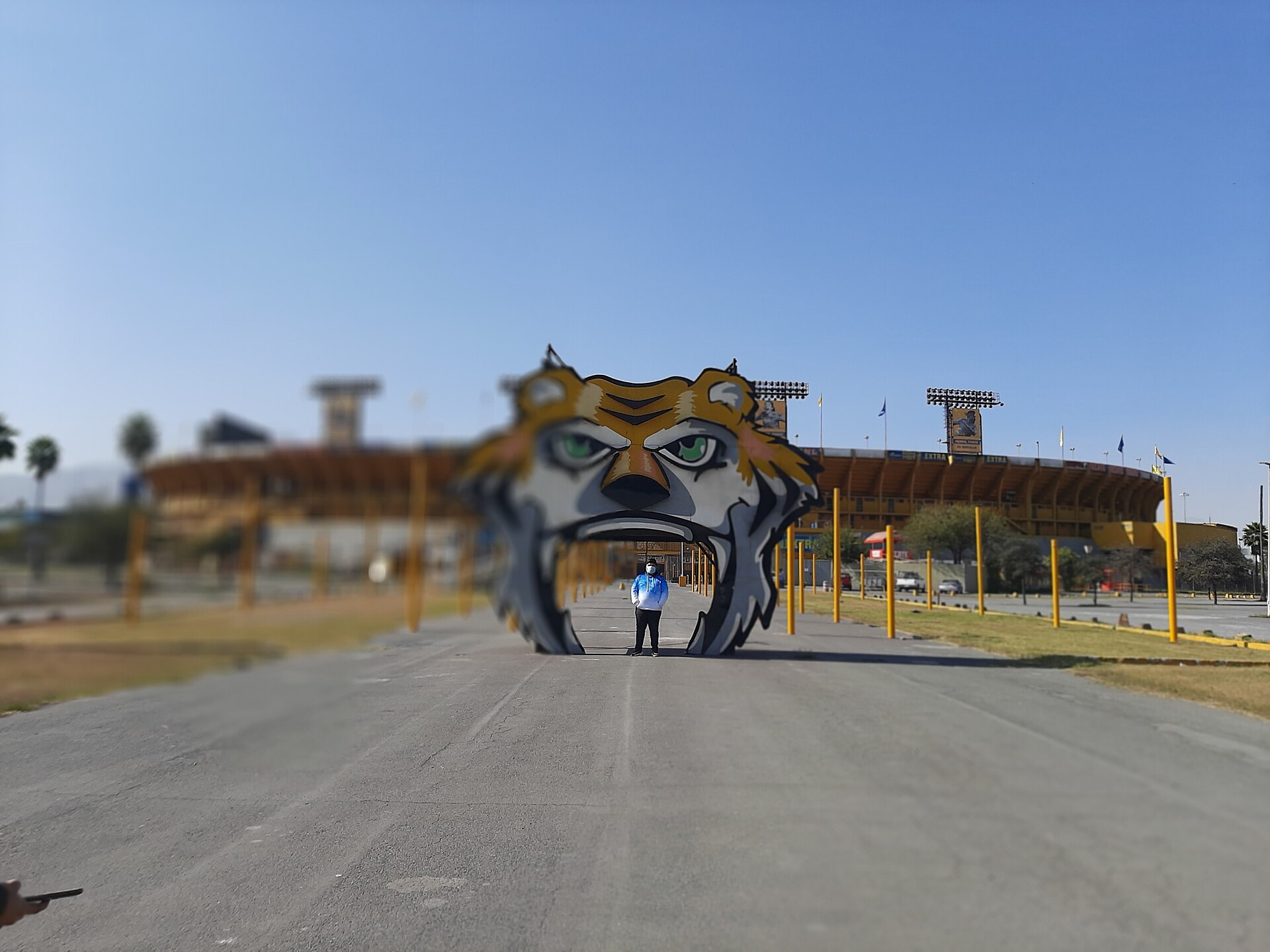
Its signature image is the tiger-head gate, a giant feline mouth through which fans pass on the way in — one of the most photographed entrances in Mexican football and a near-mandatory stop for any visiting supporter's camera. The most committed supporters gather behind the north goal, where the matchday choreography begins long before kickoff.
A gameday here is an event that spills well beyond the ninety minutes. The campus and surrounding streets fill with vendors, families, and the slow procession of yellow shirts converging on the stadium for hours beforehand. Inside, the singing rarely stops. For a first-time visitor, the sensation is less like attending a sporting fixture and more like being absorbed into a single, organized roar.
Legends and the Gignac Era
No figure defines modern Tigres more than André-Pierre Gignac. The French striker arrived on a free transfer in June 2015, at a moment when many in European football assumed his best years were behind him. Instead he became the greatest foreign signing the club has ever made and, by most accounts, one of the finest imports in Liga MX history. He is Tigres' all-time leading scorer, having passed 200 career goals for the club, and he was central to the championship run that turned the team into a dynasty.
Gignac's defining individual moment came at the 2020 FIFA Club World Cup, where he scored in the run to the final and finished as the tournament's standout attacker, taking the Silver Ball as the competition's second-best player behind Robert Lewandowski. That a Frenchman chose to spend the prime and twilight of his career in Monterrey — and embraced the city so fully that he became a naturalized local hero — remains a point of enormous pride for the fanbase.
Tigres' golden generation extended well beyond him, anchored for years by the long-serving Argentine goalkeeper Nahuel Guzmán, a cult figure in his own right behind the same north goal where the ultras gather. It is also worth noting that the club's women's team, Tigres Femenil, has been the most successful side in the history of Liga MX Femenil, with six league titles — a record that has made the women's program a genuine pillar of the institution rather than an afterthought.
Libres y Lokos and the Clásico Regiomontano
The soul of the matchday is Libres y Lokos, the club's organized supporters' group. Their origin is bound up with the club's lowest point: the group coalesced around the 1996 relegation battle, taking their name from a rock album and turning a moment of crisis into a permanent identity built on loyalty and noise. Unlike many big Mexican clubs, which host several competing barras, Tigres is followed by a single unified animation group — and that unity is part of why the sound from El Volcán is so overwhelming. They occupy the north end, decorate the players' tunnel with banners, and keep the chants running continuously from before kickoff to the final whistle.
The defining rivalry is the Clásico Regiomontano, Tigres against Rayados de Monterrey. It is one of the fiercest derbies in the Americas precisely because it is so local: both clubs draw from the same metropolitan area, the same streets, sometimes the same families. The fixture splits households and offices, and a derby weekend transforms the entire city. The women's version of the rivalry has been just as intense, with Tigres Femenil and Rayadas meeting repeatedly in finals and dominating the women's league between them.
For a visitor, the Clásico is the ultimate ticket and the hardest to get. It is also the one match where neutrality is genuinely difficult — the atmosphere demands that you pick a side, and most newcomers find themselves swept into one.
How to Attend a Match
Estadio Universitario sits in San Nicolás de los Garza, northeast of central Monterrey. The most reliable way to reach it on a matchday is the Metrorrey light-rail system, which serves the university area and spares visitors the considerable traffic and parking strain around the ground; from there it is a short, well-marked walk in a moving river of yellow. Rideshare and taxis work too, but expect to be dropped a few blocks out as roads close near kickoff.
Tickets are sold through the club's official channels and authorized box offices. For ordinary league fixtures, seats are usually obtainable in advance without much trouble; for the Clásico Regiomontano or a playoff (Liguilla) match, plan well ahead, as demand is high and resale prices climb sharply. Buying through official outlets is strongly advised to avoid counterfeits.
On etiquette: wear yellow if you want to blend in with the home crowd, and understand that the north end behind the goal is the heart of Libres y Lokos — energetic, standing, and not the place for a quiet evening. Arrive early to take in the pre-match buildup and the tiger-head gate, keep valuables secure in the crush, and be prepared to stand and sing. Visiting supporters of the opposing club should exercise normal derby caution, especially around the Clásico.
Where Things Stand in 2025-26
Tigres remains one of the heavyweight clubs of Mexican football, and the 2025-26 cycle has kept it firmly in contention on multiple fronts. The team is now led by Guido Pizarro, the former Argentine midfielder and club captain who retired as a player to take over as head coach and has since had his contract extended into 2027 — a sign the institution is betting on continuity under a figure who knows its dressing room intimately. Gignac, remarkably, has continued into the latter stage of his career still wearing the yellow, alongside a squad reinforced with established Liga MX and international names.
The most recent high-profile chapter came at continental level. Tigres reached the final of the 2026 CONCACAF Champions Cup, the region's premier club competition, only to fall to Toluca at the very end: after a 1-1 draw, with Tigres equalizing late in extra time, Toluca won 6-5 on penalties on 30 May 2026. It was a painful way to lose, but reaching the final underlined that Tigres continues to operate at the top tier of the region rather than coasting on past glories.
For a visitor planning a trip to Monterrey, the practical takeaway is simple. Tigres is not a museum piece; it is a live, contending club playing in front of one of the most committed crowds in the Americas. A night at El Volcán is, for many travelers, the single most intense and characteristically regiomontano thing they will do in the city.